Wards and Precincts of Grand Rapids

Welcome to the first official post here on the Blue Bridge Blog! As the title suggests this post will be focusing on the differences between wards and precincts and detailing why knowing which is which is important if you want to be an informed and participating member of your community.

Grand Rapids is a city of just about 200,000 people which makes it the second largest city in the state of Michigan. With that being sad, that is a lot of people who fall under the jurisdiction of the city government. So just how does the government of the city of Grand Rapids manage to govern such a large group of people in an effective manner?

Well if you’ve ever wondered about that or had questions regarding just what a “precinct” or a “ward” is then allow me to help shed some light on the subject!

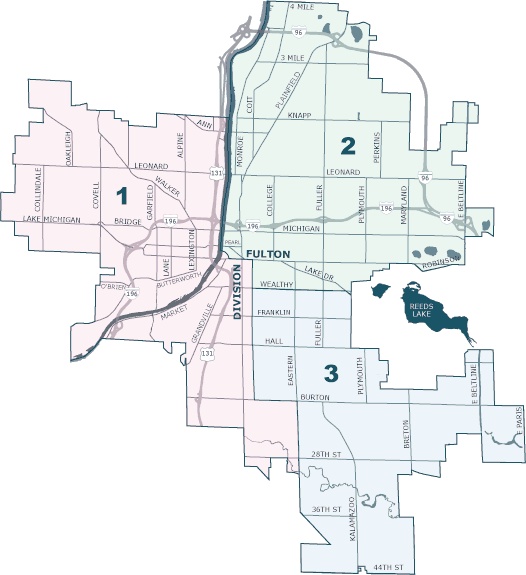
The city of Grand Rapids is divided into three distinct wards which are simply defined areas that divide the population of Grand Rapids into electoral districts for local elections. Each of the three Grand Rapids wards have two elected ‘Ward Commissioners’ who serve 4 year terms before coming up for reelection. The 1st Ward is currently being represented by Jon O’Connor and Kurt Reppart; the 2nd Ward is represented by Joseph D. Jones and Milinda Ysasi, and finally 3rd Ward is represented by both Senita Lenear and Nathaniel Moody. Below is a map of the three Grand Rapids wards and the areas that they represent.
So what the heck is a precinct then? Put simply a precinct is a subdivision of a ward where polling stations are located for citizens to use on election day. People living in each precinct vote at the same location on election day and a full list of the 77 Grand Rapids precincts can be found on the Kent County website at.. https://www.accesskent.com/Departments/Elections/Polling_Locations/grand_rapids.htm

Most precinct’s designated voting locations are placed at public spots that have some sort of significance to the community; such as a church, schools, or community centers. Voters living in the same precinct all use the same location to vote when election day comes around each year.

So in short that sums up what the main differences between the Grand Rapids wards and precincts and why knowing where you live with respect to each is important when attempting to be an informed member of your local community. Be on the look out for a detailed breakdown of your local elected officials written by Grayson coming soon and be sure to subscribe so you never miss a post!

Is the County Drain Commissioner more powerful than the Governor?

I remember running with my cross country team through some neighborhoods last election season, only to be completely floored by one of the yard signs that read: “RACHEL HOOD (D) FOR DRAIN COMMISSIONER”.

Now if you are most people, you probably have a limited understanding of what a drain commissioner is, why it is a ‘Republican vs Democrat’ position, and why its even an elected position in the first place. I’ll briefly provide an answer to all three, as well as reasons why this position may be more powerful than the governor.

What is a drain commissioner? According to the office website, the mission of the drain commissioner is “to improve and maintain storm water drainage for the public health, safety, convenience, and welfare of the citizens of Kent County [and be] stewards of our natural and fiscal resources.” Put into practice, this means being an overseer of 500 miles of county water drains and managing how water runoff affects mall parking lots, farms, forests, lawns and urban areas. If downtown GR floods, for instance, it’s on the drain commissioner to engineer a solution.

Why is this a partisan position? While the original intentions of Michigan lawmakers is unclear, the most recent election for drain commissioner might be a helpful example. Both candidates in the race often were asked what their vision for the drain commissioner was. Rachel Hood (D), envisioned that the drain commissioner’s office should be renamed to the ‘Water Resource Commission Office’, and have responsibilities that are beyond what is typical for the role. Her opponent, Ken Younker (‘R) believes that changing the responsibilities as such would be expanding the role into operating where the Michigan Department of Environmental Quality should be operating.

While it is possible to have a non-partisan race where opponents differ on the vision and role of the office, aligning with a political party is just a pragmatic way to secure funding and votes.

…so why is a drain commissioner more powerful than the governor?

Alright, this is kind of a stretch, but what kind of bloggers would we be if we didn’t use tasteful clickbait? Joking aside, there are reasons to believe that the drain commissioner has more ‘power’ than the governor. By power, we really mean that he has the ability to do things without outside restrictions. The drain commissioner has the unique ability to both impose taxes and borrow money without any restrictions. Normally whenever a new tax is to be imposed, there must be some kind of vote to make sure that it is supported democratically.

But not for the drain commissioner.

The drain commissioner can raise local taxes without any short-term checks. Sure, in the long term voters can always elect someone else, but no other office in the state of Michigan has that kind of unchecked power.

Township vs. City Government

As we’ve established, Grand Rapids is the 2nd largest city in the state of Michigan and with that distinction comes difficult distinctions between people being governed by the city of Grand Rapids and Grand Rapids township. So what do the differences between the Grand Rapids city government and the township government look like? How do they interact and cooperate while attempting to govern? Let’s take a look.

Let’s start with Grand Rapids Charter Township and how it is different from the city of Grand Rapids. Grand Rapids Charter Township is located directly to the East of the city proper withing Kent County and governs just over 16,500 people as of the 2010 census. The township government is comprised of a multitude of boards and commissions that each are in charge of different aspects of the township. Elections are held for the Township Board, the Economic Development Corporation and the Planning Commission who carry out various functions within the township. The other commissions and boards are made up of appointed officials who serve on the boards or commissions in a part time role. As we can see Grand Rapids Charter Township exists as an entirely separate entity from the city of Grand Rapids and its government is constructed differently.

The city of Grand Rapids is in charge of governing just under 200,000 residents so right away the scale of the two governments is a lot different. Grand Rapids as a city also features both elected and appointed officials who exercise more power in government compared to the average board member from the township. The elected positions within Grand Rapids include; Mayor Rosalynn Bliss, the six Ward Commissioners who represent the three wards of Grand Rapids, and the City Comptroller Max Frantz. The six city Commissioners and the Mayor comprise the City Commission who then appoint the City Manager, Clerk, Treasure and City Attorney. Citizens can also apply to serve on a multitude of boards each with their own role to play in Grand Rapids.

Clearly the challenges faced by both the township of Grand Rapids and the city are unique in their own respects and thus governing these municipalities has to be done in a different way. The city obviously places a higher emphasize on the individuals who are elected to various positions, while the township is more concerned with organizing the elected officials into boards and commissions where they can do the most good for their constituency’s.

Hopefully this has helped clear some of the air around what the differences between Grand Rapids Charter Township and the City of Grand Rapids are! As well as answering the question of why do we have both here in Kent County. As always be sure to subscribe for more content and be sure to be on the lookout for our first interview with an elected official coming soon!

So… What is a City Commissioner?

So if you personally identified with the introduction and not knowing what a city commissioner is, have no fear! We weren’t planning on leaving you out to dry for long. Below is a list of some of the common positions you’ll find within a local government (including Grand Rapids!).

So… what are the elected roles for the city of Grand Rapids?

Mayor- the CEO of the municipality (think town or city), mayors have a variety of responsibilities ranging from financial planning to public safety management. However, there isn’t a definitive list of responsibilities- it largely depends on local laws. In Grand Rapids, the position is weaker and 20 hours per week is the expected mayoral workload. 

Ward Commissioner- Commissioners are elected by the people within their ward (basically just a chunk of the city) to write and amend local laws. Grand Rapids decided to use the term ‘ward commissioner’ to describe this role, but in many cities they’re simply referred to as city commissioners.  In addition, many ‘commissioner’ type roles are a blend of writing laws and executing them. 

City Comptroller- A comptroller is the ‘head accountant’ of the city. They typically keep track of financial records, creating balance sheets, and monitoring internal compliance (for some reason I always picture a hall monitor mixed with an accountant). If thinking of the mayor as the CEO is a helpful analogy, then think of the comptroller as the CFO.

——–

What are the roles that oversee Kent County then?

District Commissioner– Glance back up to Ward Commissioner, but do a mental exercise where you replace ward with district. Districts are much bigger than wards and encompass large swaths of the county. Together, they make local laws about said county.

Drain Commissioner– Yes, Kent County has an elected person to oversee… drains? Michigan is pretty unique with this one. Later we’re going to do a more in-depth dive on this role (we swear it’s more interesting than it sounds), but, for now just know that this is the person responsible for doing damage control when storm water gets out of hand.

Prosecuting Attorney- On a county level, the prosecuting attorney represents the the citizens of Kent County in court in the event that they are victims of crime. 

Sheriff- Sheriffs are elected to serve both their constituencies, their state’s constitution, and the United States Constitution. What this means in practice is overseeing the law enforcement in her county, similar to how the police chief of a city operates (Detective Sergeant Hank Voight for our Chicago P.D. watchers).

It is an elected position so that the sheriff remains accountable to the citizens. Just as the city comptroller internally audits and reviews the city’s financial documents, a sheriff makes sure law enforcement is following correct procedure… and with great incentive! If law enforcement messes up it tarnishes the sheriff’s record, and s/he has to face the people when it comes to re-election!

Treasurer- If you thought money when you saw treasure, that would be correct. The Treasurer of a county collects taxes on property and trailers as its main source of revenue. Those funds typically will be invested in the county- In the case of the glorious county of Kent, Treasurer Parrish has created a pool of resources that local governments can access for a safe, sustainable investment. This makes sure that localities can keep growing in the long term!

——

There’s a quick rundown of the common positions in local politics, as well as a high-level overview of their responsibilities. But who is my ward commissioner? What are their values and qualifications? Are they even human? 

If you think I’m kidding about that last one I’m not. Sweet Tart is a cat with a lot of political ambition, taking the mayoral election of Omena, Michigan paws down. Check out that story here. 

Does Grand Rapids have humans elected to its local government? Subscribe for future content. My (Grayson here) next post will be detailing the current elected officials more closely.

Wards and Precincts of Grand Rapids

Welcome to the first official post here on the Blue Bridge Blog! As the title suggests this post will be focusing on the differences between wards and precincts and detailing why knowing which is which is important if you want to be an informed and participating member of your community.

Grand Rapids is a city of just about 200,000 people which makes it the second largest city in the state of Michigan. With that being sad, that is a lot of people who fall under the jurisdiction of the city government. So just how does the government of the city of Grand Rapids manage to govern such a large group of people in an effective manner?

Well if you’ve ever wondered about that or had questions regarding just what a “precinct” or a “ward” is then allow me to help shed some light on the subject!

The city of Grand Rapids is divided into three distinct wards which are simply defined areas that divide the population of Grand Rapids into electoral districts for local elections. Each of the three Grand Rapids wards have two elected ‘Ward Commissioners’ who serve 4 year terms before coming up for reelection. The 1st Ward is currently being represented by Jon O’Connor and Kurt Reppart; the 2nd Ward is represented by Joseph D. Jones and Milinda Ysasi, and finally 3rd Ward is represented by both Senita Lenear and Nathaniel Moody. Below is a map of the three Grand Rapids wards and the areas that they represent.

So what the heck is a precinct then? Put simply a precinct is a subdivision of a ward where polling stations are located for citizens to use on election day. People living in each precinct vote at the same location on election day and a full list of the 77 Grand Rapids precincts can be found on the Kent County website at.. https://www.accesskent.com/Departments/Elections/Polling_Locations/grand_rapids.htm

Most precinct’s designated voting locations are placed at public spots that have some sort of significance to the community; such as a church, schools, or community centers. Voters living in the same precinct all use the same location to vote when election day comes around each year.

So in short that sums up what the main differences between the Grand Rapids wards and precincts and why knowing where you live with respect to each is important when attempting to be an informed member of your local community. Be on the look out for a detailed breakdown of your local elected officials written by Grayson coming soon and be sure to subscribe so you never miss a post!

Create your own website, free on WordPress.com.Create your own website.
Start free